There are, however, rules to be observed if you want to exploit the cloud in full compliance and tips to know if you want to navigate contracts and key provisions.
Widespread use of the cloud
For several years now, the digitalisation of businesses and services has been more prevalent, primarily due to the opportunities provided by the cloud.
Naturally, the use of the cloud must take into account the applicable legal framework. Given the many regulations that apply and the multiple levels of regulation (ranging from European and national obligations to rules issued by different authorities and regulators), this is becoming an increasingly complex task.

Illustration data & cloud Photo libre de droit fournie par PwC Legal Luxembourg
Current challenges of the cloud
From a legal and contractual perspective, here is a (non-exhaustive) list of points to consider:
- A clear definition of the roles and responsibilities of each organisation offering or operating cloud services;
- The exact knowledge of the location(s) where data is stored and the entire chain of subcontractors that have access to data stored in the cloud;
- The strict rules relating to international transfers of personal data arising from the GDPR1 and current case law and/or restrictions applicable in certain sectors, in particular where professional secrecy applies (especially as regards regulated entities in the financial sector);
- Data security and confidentiality (e.g. access management, technical encryption solutions and key access, security measures, etc.);
- The definition of reasonable retention periods for data in the cloud, and the assurance that this data will be effectively deleted by the service provider.
Risk management in contracts
Certain organisations using the cloud have the common misconception that they are not responsible if something goes wrong.

Certain organisations using the cloud have the common misconception that they are not responsible if something goes wrong. This is a risky viewpoint because, even when data is hosted by a third party, every organisation must retain control of its data and ensure that it is secure. Companies must therefore choose their service provider wisely, or otherwise risk being held (also) liable.
Thus, a contract providing a legally sound framework with a clear division of each party’s obligations is essential.
Furthermore, European legislation (in particular the GDPR and Dora2, which will be applicable from 17 January 2025) as well as certain local rules (in particular the CSSF circular on outsourcing arrangements3) stipulate the obligation to sign a written contract containing a number of elements such as audit clauses, subcontracting provisions, agreed service levels, etc.
Given the ever-increasing complexity of the subject and the stakes in terms of liability, it is essential to consult a legal expert who specialises in this area.

Illustration data & cloud Photo libre de droit fournie par PwC Legal Luxembourg
Cloud & Dora: strength in numbers
The Dora Regulation creates a framework for managing IT-related risks, with the main aim of ensuring the resilience of entities that fall within the very broad scope of the Regulation, which covers not only financial entities (in the broadest sense) but also ICT service providers.
The cloud can be a means of meeting Dora’s objectives to improve an organisation’s operational resilience, security, robustness and collaboration. However, cloud deployment needs to be carefully considered in terms of the geographical distribution of servers, backup measures, access controls and liability.
Cloud & AI: a winning duo
Artificial intelligence (AI) can also be used to increase the potential of the cloud tenfold. AI is an essential element, given the ever-increasing number of data stored by organisations in the cloud. In particular, AI helps to analyse data flows, improve cloud performance and identify and prevent security threats more effectively, among others.
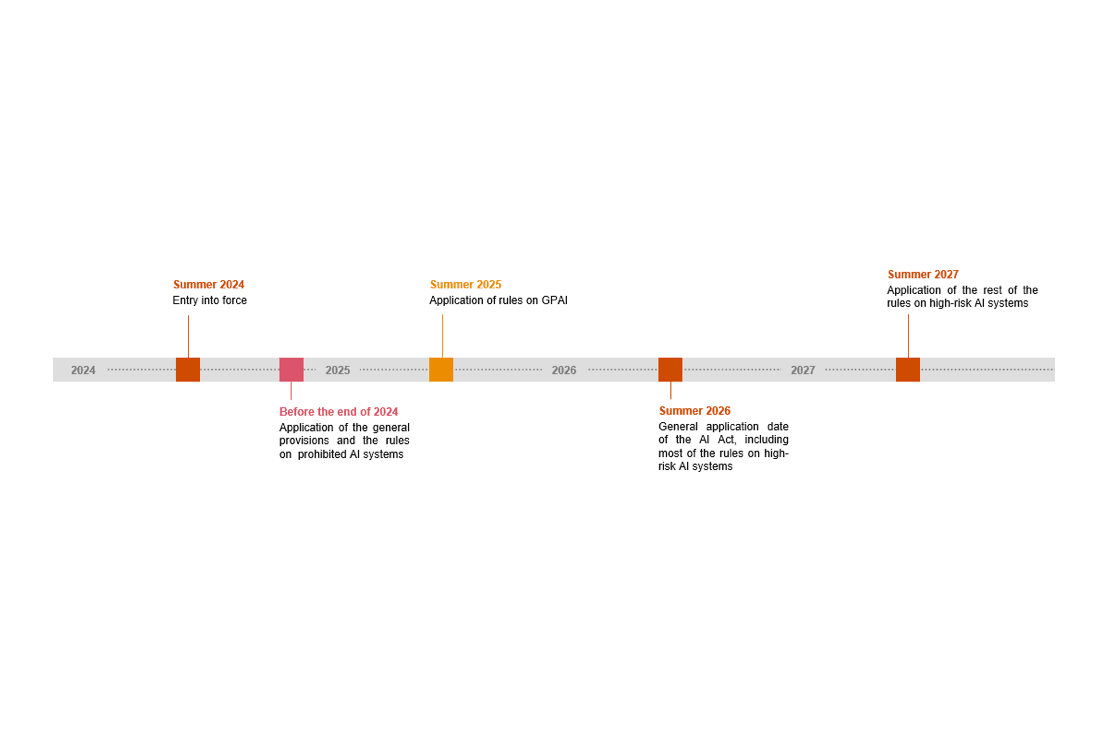
AI is itself the subject of specific regulation at European level, which is a world first. This regulation, which is currently being finalised at legislative level and will soon be applicable (see image below), includes a whole series of legal provisions governing AI systems using a risk-based approach (with obligations and restrictions varying according to the different levels of risk).
Cloud compliance: strategic and legal solutions PwC Legal
Given the ubiquity of these AI-based technologies, it is important for both the companies developing this software and those using it to be prepared for the legal obligations and to include essential provisions in this regard in their contracts.
Conclusion
The cloud, capable of processing vast data volumes and offering global access, becomes an ideal accelerator, allowing a form of digital ubiquity.

Technology underpins digital transformation within organisations, with the cloud playing a pivotal role. To create value in a globalised setting, IT infrastructure must adapt, addressing the growing needs for agility, performance and security.
The cloud, capable of processing vast data volumes and offering global access, becomes an ideal accelerator, allowing a form of digital ubiquity.
However, innovation must be achieved in a highly regulated and increasingly complex environment. The key to successful use of the cloud will necessarily involve the support of technical and legal experts throughout the process.
PwC Legal assists numerous public and private sector clients with strategic and contractual issues, thanks to its deep legal and technological expertise.
1Regulation (EU) 2016/679 of 27 April 2016 on the protection of natural persons with regard to the processing of personal data and on the free movement of such data.
2Regulation (EU) 2022/2554 of 14 December 2022 on digital operational resilience for the financial sector.