
The SWIFT CSP requires organizations to adhere to defined security control objectives. This set of controls establishes a security baseline in line with information security industry standards for the SWIFT community and users. However, beyond compliance for the sake of compliance, organizations can carry out activities on SWIFT networks and their supporting components to reduce the risk of a breach and enhance the overall security of core business activities.
Whether a sophisticated threat actor or an internal employee is behind an attack, an organization’s industry and country can give rise to many threat vectors. There are three general scenarios:
External attack
Social engineering is an effective entry point into an organization’s internal network. Organizations with shadow IT may also be exposed to external threat actors if an internet-facing server is put into production without following internal processes and procedures, or when such a server falls out of the patching lifecycle.
Internal attack
The risk of an internal attack can be especially high in these non-exhaustive scenarios:
· Security control bypass caused by architecture design issues
· Incorrectly implemented or misconfigured controls
· Inadequate OS- or application-level hardening
· Governance issues in user provisioning and privilege assignment
· Permission misconfiguration or bypassable four-eyes principle
· Over permissive or lack of overview of the firewall rule
Insider attack
Those tasked with designing, implementing and maintaining security controls are in the best position to disrupt or bypass them. This applies to both IT administrators attempting to bypass implemented technical controls, and business end-users potentially subverting business imperatives.
Deloitte has demonstrated the plausibility of some of these scenarios during red teaming or penetration testing engagements on SWIFT environments. Organizations should particularly consider the attack patterns of leveraging social engineering techniques and exploiting external systems connected to SWIFT.
The SWIFT infrastructure and its supporting components are a complex system. Therefore, organizations must have a clear understanding of this system and the implemented controls.
· Implemented controls should be verified by technical tests for operating effectiveness and implementation.
· Independent technical-level assessments of these controls provide an external perspective on control implementation, reducing the risk of compromise.
· Associated components outside the secure zone can also be compromised to the same effect as a secure zone compromise. Depending on their setup, organizations should consider following advisory controls from the SWIFT Customer Security Control Framework, especially “2.4 A Back Office Data Flow Security”.
· Finally, organizations must consider the human factor and conduct regular security awareness sessions for all staff members, including role-specific training for SWIFT operators with privileged access.
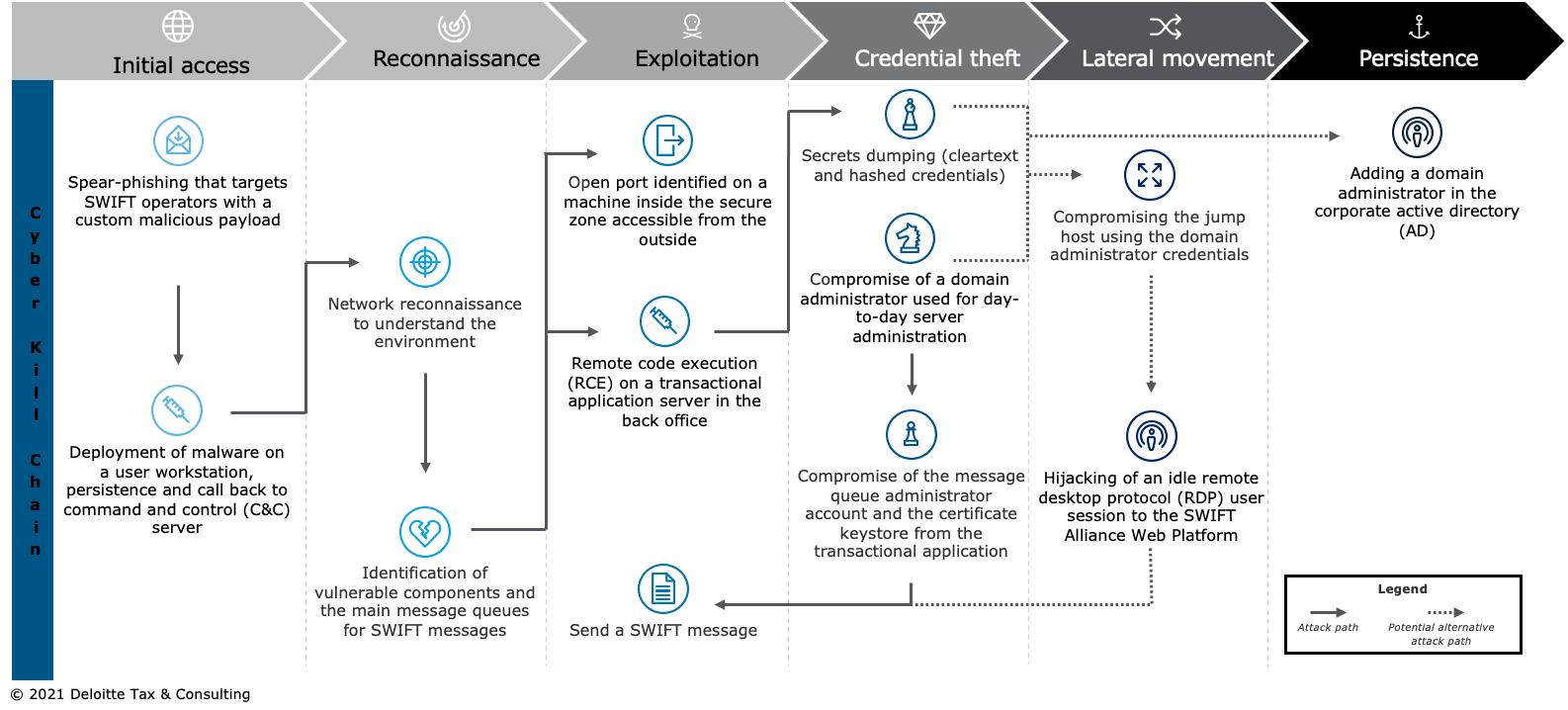
Example of a cyber kill chain in a SWIFT environment Deloitte Luxembourg
To discover how we can support your SWIFT CSP needs, click here.